- EraEarly Dynastic Period
- Project DirectorDavid O’Connor and Matthew D. Adams
- LocationSohag Governorate
- AffiliationAmerican Research Center in Egypt (ARCE)Institute of Fine Arts, New York University
- Project SponsorUSAID
- Project Dates1999 – 2006 and 2010 – 2012
Written by: Matthew D. Adams and Wendy Doyon
In the remote desert site of Abydos, in southern Egypt, stands a huge mud brick structure known today as the Shunet el-Zebib (“storehouse of raisins”), or the “Shuneh,” for short. The structure’s present timeworn appearance gives little clue to its singular significance in ancient Egyptian history and culture. Built of two concentric, rectangular enclosure walls covering an expansive area of more than 10,000 square meters, the Shuneh continues to dominate the desert landscape today as it has since its construction nearly 5000 years ago. The inner “main” enclosure still stands to near its original height of around 11 meters, with walls 5 meters thick. The outer enclosure was not as high, reaching around 7 meters. These walls bounded an interior space open to the sky that today gives little indication of its ancient purpose.
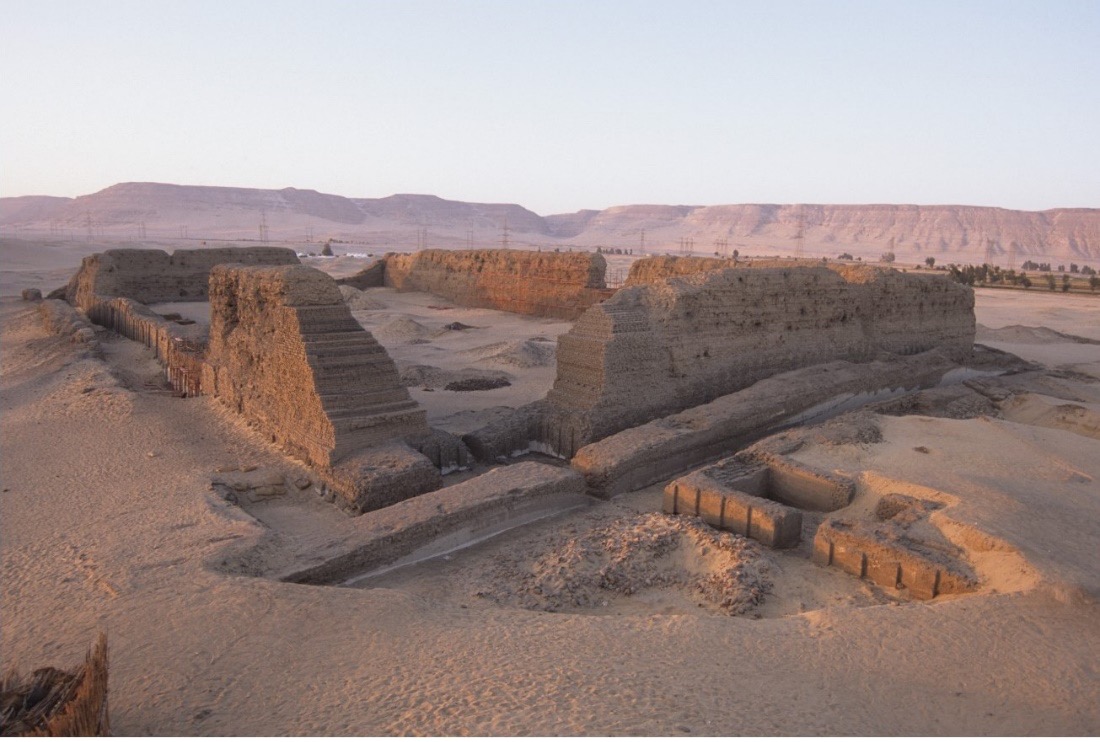
General view of Shunet el Zebib enclosure with adjacent Peribsen enclosure.
We now know that this enigmatic structure is, in fact, Egypt’s oldest surviving royal funerary temple and sole surviving example of ancient Egypt’s first royal monumental building tradition. It is today the most visible symbol of the emergence of kingship at the beginning of Egyptian history. It was built by King Khasekhemwy, last king of the Second Dynasty, ca. 2700–2680 BCE. Khasekhemwy was also the last early king to be buried in Egypt’s first great royal necropolis at Umm el-Qa‛ab, situated at an isolated location at Abydos some 1.75 km south of the Shunet el-Zebib. The royal cemetery at Umm el-Qa‛ab is the forerunner of later royal cemeteries at Saqqara, Giza, and Luxor’s Valley of the Kings.
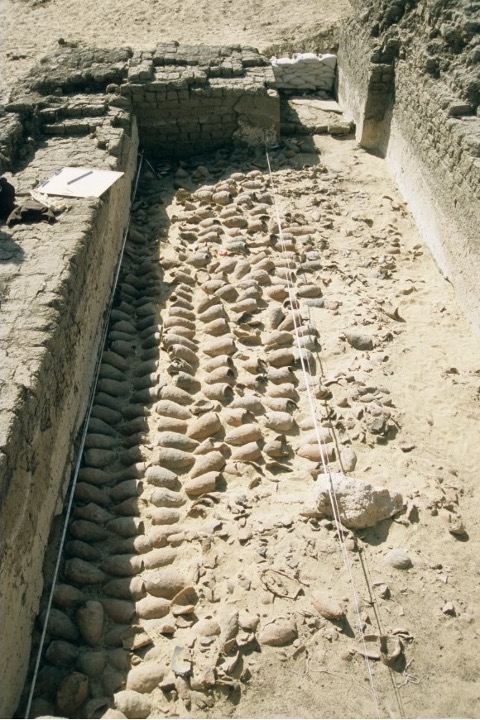
Chamber with deposit of offering pottery in the North gateway area.
Each of the kings of the First and Second Dynasties who constructed a tomb at Umm el-Qa‛ab also built a monumental cult place on the desert edge overlooking the ancient town. These cult places, or ritual enclosures, served as funerary temples for each king and as the visible monumental component of each royal funerary complex. The Shuneh is the only one of these monuments still standing today. In the apparently empty desert around it are the buried remains of the enclosures of Khasekhemwy’s predecessors, likely beginning with King Narmer, first king of the First Dynasty. Many elements of the design of the Shuneh were copied in stone in the pyramid complex of Khasekhemwy’s successor, Djoser, situating Khasekhemwy’s Abydos monument squarely in the evolution of the architecture of the royal pyramid complex
Excavations at the Shuneh have produced considerable evidence of its ancient use. Most significantly, huge deposits of discarded ceramic vessels, mainly beer jars, that also included bovine crania, charcoal (possibly from burning incense), and broken sealings from opening containers of various kinds, are the material remains produced by the making of offerings, the fundamental performative ritual in Egyptian religious practice.
These deposits demonstrate that rituals in which offerings were made, perhaps to the king himself, were an essential function—perhaps even the primary purpose—of the enclosure. The enormous scale of the deposits of discarded material is a direct measure of the scale of the rituals once conducted inside the monument. Similar deposits found at other royal enclosures at Abydos show that the ritual use of Khasekhemwy’s monument was not unique, but rather part of a broader pattern of activity that served to establish the nature of kingship at the beginning of Egyptian history.
The ritual use of the monument appears to have been limited to the reign of King Khasekhemwy, up to the time of his death and burial. Sealings with the name of Netjer-khet Djoser, Khasekhemwy’s successor and likely son, indicate that Djoser oversaw the burial of his predecessor. Parallel evidence from Khasekhemwy’s tomb at Umm el-Qa‛ab supports this idea. After the end of the Second Dynasty, the monument appears to have stood largely untouched—for nearly two millennia—until the end of the New Kingdom, ca. 1070 BCE, when the interior began to be used as a burial place for sacred animals.
Initially, these included both dogs and ibises, but eventually the burials were reserved almost exclusively for the sacred birds. Excavations have produced thousands of examples, likely only a portion of those once deposited at the monument in large pits. The use of the Shuneh as a sacred animal cemetery continued into the Hellenistic period, 332–30 BCE, after which it again appears to have stood largely untouched for many more centuries.
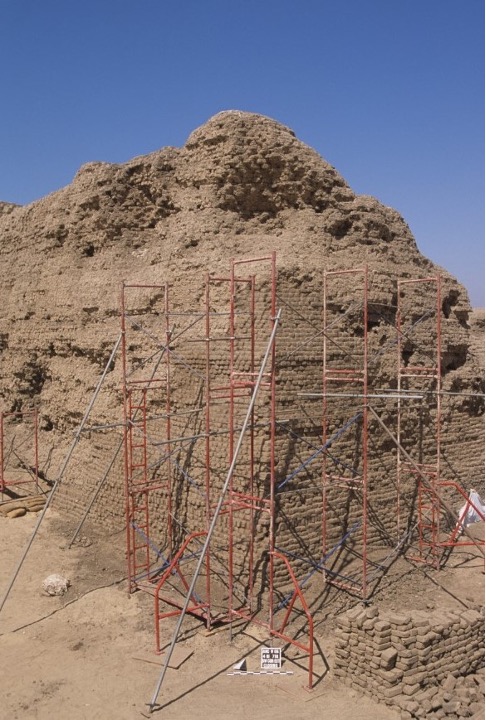
Stabilization work on the southwest corridor exterior.
The monument’s third and final phase of ancient use was in the late Roman, or Byzantine, period (fourth–seventh centuries CE), when it was adapted to serve as the base for an early Christian monastic community. Suites of rooms were built against the walls, to serve both as living spaces, with kitchens, storerooms, and work areas. Each suite also included a dedicated prayer room, or oratory, cut into the fabric of the ancient walls.
Once again, the Shuneh appears to have stood largely untouched after the fifth or sixth century CE. Eventually the unsupported brick masonry above the monastic rooms began to collapse, as did the original gateways. Over time, each localized area of structural instability gradually enlarged through a cascading series of small collapses, until the walls came to be characterized by huge voids and deep cracks.
At the same time, the walls were further damaged by two animal species: the Oriental Hornet (Vespa orientalis), and the common sparrow (Passer domesticus), both of which burrow into the walls to build nests. The sparrows create small voids as deep as 30 cm, while hornet burrows have been documented as deep as 1.5 m. Each type of void represents a localized area of structural instability that gradually enlarges over time, with neighboring voids eventually interacting to create much larger holes, which in turn trigger further localized collapses.
More recent human activity has also affected the condition of the monument. Important, though poorly documented, excavations in the mid-19th century of the Shuneh’s interior, for example, left most of the length of the main enclosure’s east wall seriously undermined. As a consequence, nearly half the original masonry of this wall was subsequently lost.
With support from ARCE’s Egyptian Antiquities Project (EAP), David O’Connor and Matthew Adams began a major initiative focused on the documentation and preservation of the Shunet el-Zebib. This began with the systematic documentation and assessment of the existing condition of the monument, 1999–2001, on the basis of which a comprehensive architectural conservation plan was developed. The implementation of conservation solutions began in 2004, with the continued support of EAP and EAC (Egyptian Antiquities Conservation) funding from ARCE through 2012, and with additional funding from an ARCE Antiquities Endowment Fund (AEF) grant for work in 2009. The ARCE/USAID-supported work at the Shunet el-Zebib has formed a major component of the broader research and conservation program of Abydos Archaeology, a long-running archaeological project sponsored by the Institute of Fine Arts, New York University (formerly known as the Penn-Yale-IFA Expedition).
The basic conservation solution employed at the Shuneh is the replacement of missing original masonry in areas of structural instability. This is achieved using new mud bricks, which are locally fabricated to specifications based on the analysis of the components and properties of the original mud bricks. The goal of the conservation program is not to restore the monument to anything like its original finished condition, which, given environmental weathering, would only have existed for a relatively short time. Rather, the new masonry is intended to blend aesthetically with the original fabric of the monument, preserving its present visual character, one that reflects its 5000 years of extraordinarily rich history. Upon close inspection, however, areas of new masonry can be easily identified.
A different approach has been taken at the four original gateways. In these areas, the structural requirements of stabilization are considered together with the presentation value of the gateways. The Ministry of Tourism and Antiquities is presently working to integrate the Shunet el-Zebib into visitor itineraries at Abydos, and the gateways represent key locations through which something of the original nature and purpose of the monument can be conveyed to visitors. Consequently, the gateways are being partly reconstructed to show the original formality of the architecture; to re-establish the closed and bounded character of the interior ritual space; and to guide the movement of visitors into and out of the structure.
With ARCE’s support, approximately two-thirds of the needed conservation interventions were successfully completed between 2004 and 2012. But the conservation program at King Khasekhemwy’s monument is ongoing, with large-scale conservation work on part of the east wall and the southeast gateway of the main enclosure in 2019. Additional large-scale work will be required at the south gateway of the main enclosure, as will extensive treatment of the outer enclosure wall.
Learn more about the ongoing architectural conservation and archaeology of the Shunet el-Zebib at abydos.org.
CategoryARCE ProjectsTopicsConservationThemePharaohs & RulersHistoric PeriodPredynastic/Early DynasticLocationUpper Egypt